
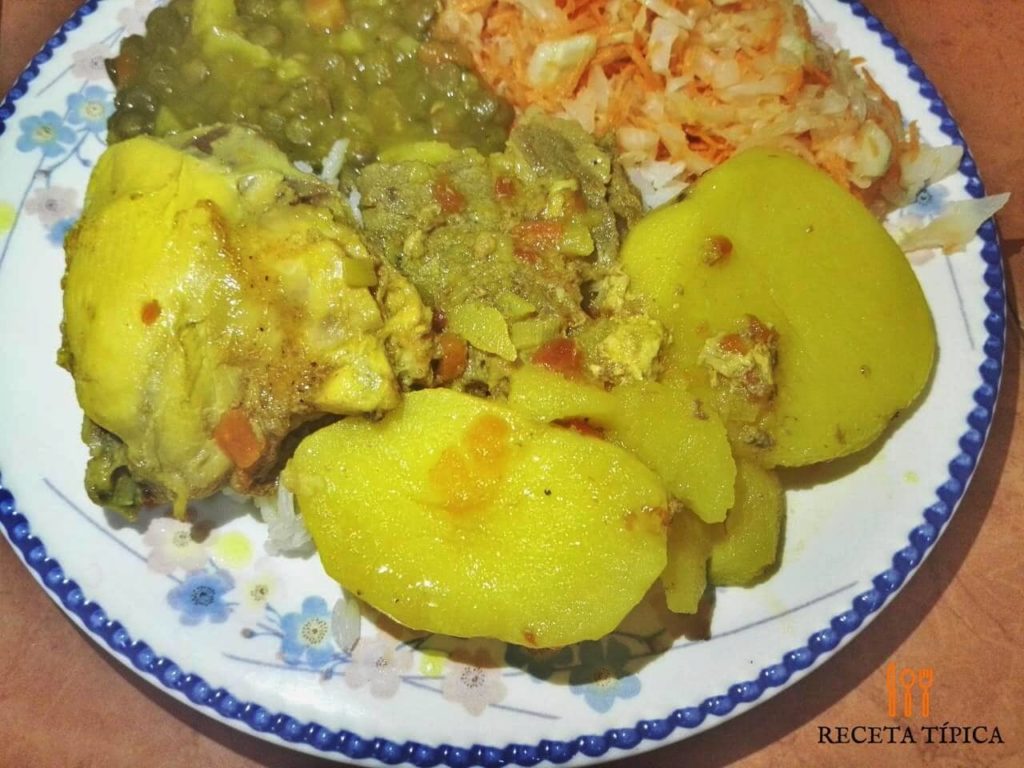
Chicken pieces stewed with potato and cassava in a blended sauce of tomato, onion and garlic, cooked down until there is almost no liquid left. Forty minutes, four servings, served over white rice.
Sudado means sweated
The name is the method. Sudar is to sweat, and a sudado is anything cooked covered, over moderate heat, in liquid that is allowed to reduce until it has almost gone.
That is what separates it from a soup, which keeps its broth, and from a fried dish, which never has any. At the end of a sudado the pot should hold chicken, potato and cassava coated in a thick sauce, with a spoonful or two of liquid at the bottom and no more.
Getting there is a matter of watching. The second step says to check the water and top it up if the pot is running dry, and that is a real instruction: cassava and potato drink a surprising amount, and a pot left alone either dries out and catches or is served too early and swims.
Or pollo guisado, depending who you ask
Both names bring people to this dish and both are correct.
Guisado is the general word for stewed in a sauce and covers a great many things. Sudado is narrower and describes this particular covered, reduced method. In practice a Colombian cook will use either word for the same pot, and which one they reach for depends more on where they grew up than on what is in it.
If you learned it as pollo guisado colombiano, this is the recipe you were looking for.
The sauce goes in the blender
Tomato, onion, garlic, the bouillon cube, the colouring and half a cup of water, all blended smooth before anything meets heat.
This is the same shortcut that turns up in the Colombian lasagna and in empanada filling, and it does two things. It saves the fifteen minutes a sofrito would need in the pan, and it gives a sauce with no visible pieces in it, which is what a sudado is supposed to look like.
It also means the tomato skins end up in the sauce rather than curling in the pan, which nobody minds once it is blended.
About the azafrán
The ingredient list asks for a pinch of saffron and it is worth being clear about what that means in a Colombian kitchen.
What is sold there as azafrán is usually a powdered yellow colouring, based on annatto or turmeric, in small sachets alongside the bouillon cubes. It is not the saffron thread that costs more by weight than silver, and no everyday sudado has ever used that.
Its job is the colour. Turmeric, or the achiote sold as color, does exactly the same thing, and real saffron threads would work too if you happen to have them.
More chicken
- Chicken and rice soup — the same chicken, in broth.
- Roast chicken — in the oven instead.
- Colombian white rice — what it is served over.
- Colombian ají — on the side.
Sudado de Pollo FAQ
Colombian chicken stew. Sudado comes from sudar, to sweat, and it describes the method rather than the ingredients: everything cooks covered in its own liquid until that liquid has almost gone.
Very little, and in most Colombian kitchens they are the same dish under two names. Guisado is the wider word for anything stewed in a sauce; sudado points specifically at the covered, reduce-it-down method.
When there is very little liquid left and what remains clings to the chicken as a thick sauce. A sudado still swimming in broth has not finished, and one stuck to the bottom of the pot has gone too far.
Almost certainly not. What Colombian shops sell as azafrán is generally a powdered yellow colouring based on annatto or turmeric. It is there for colour more than flavour, and turmeric does the same job.
Yes, and many households do, using only potato. Cassava gives a denser, slightly sweet piece that soaks up the sauce, so it is worth including if you can get it.
It takes longer than potato. Cut it into smaller pieces than the potato chunks and test it before taking the pot off the heat; it should give completely to a fork.
White rice, always, with the sauce spooned over. Slices of avocado and a piece of arepa on the side make it a full plate.
📖 Recipe

Ingredients
Sauce
- 2 tomatoes (finely chopped)
- ½ onion (finely chopped)
- 2 garlic cloves (minced)
- 1 chicken bouillon cube
- A pinch of saffron or color (what is sold as azafran in Colombia is usually a powdered yellow colouring rather than saffron threads; either works)
- ½ cup water
Stew
- 4 pieces chicken (on the bone)
- 1 tablespoon oil
- 4 or 5 potatoes (cut into medium chunks)
- 4 pieces cassava (about 2 in each, peeled)
- 3 cups water
- Salt and pepper to taste
Notas
Instructions
- Blend the tomatoes, onion, garlic, bouillon cube, saffron and half a cup of water until smooth. Set it aside.
- In a pot, put the remaining water and start cooking the chicken, seasoned with salt and pepper. Add the cassava, the potatoes and the blended sauce. Watch the water as it goes: top it up if the pot is running dry. What you are after at the end is a stew with very little liquid, not a soup and not something stuck to the bottom.
- Cover and cook for 20 to 25 minutes, stirring now and then, until the cassava gives way to a fork.
- Serve over white rice.
Comments
No Comments