
Guavas blended with water and strained, or with milk if you prefer it that way. Ten minutes, five glasses, and the seeds are what the straining is for.
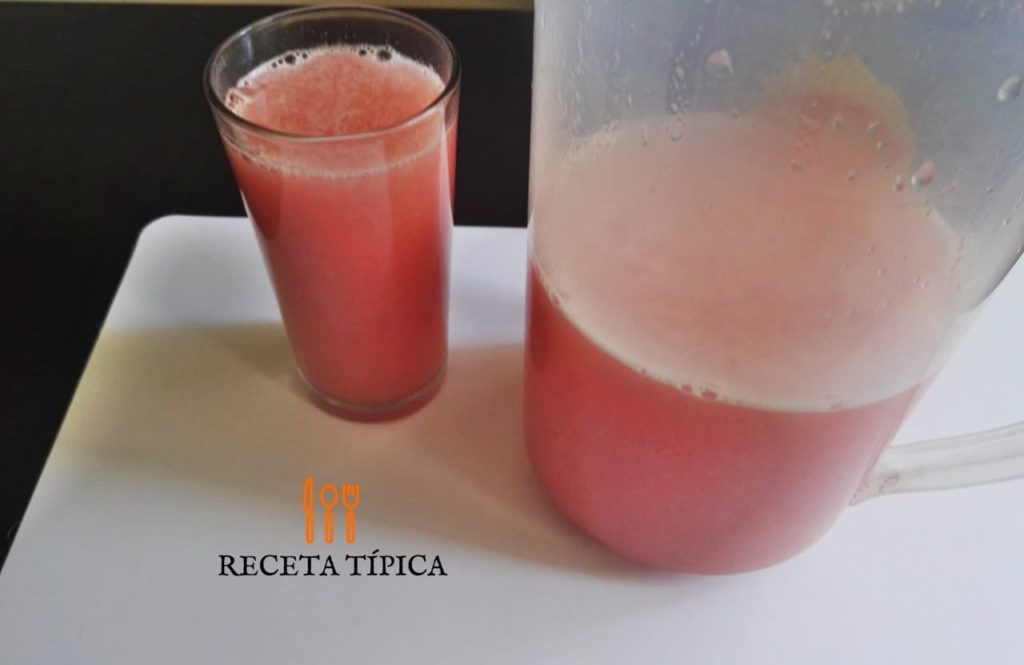
The seeds are why you strain it
Guava is one of the few fruits where straining is not optional, and the reason is the seeds.
They are small, extremely hard and there are dozens in each fruit. A blender does not break them down, it just distributes them, and what you end up with is a drink full of grit that catches between your teeth.
Thirty seconds of blending and then straight through a sieve. Press the pulp through with the back of a spoon so that only the seeds stay behind, and you keep everything worth keeping.
Water, milk, or both
The second step says water and/or milk, which is unusually flexible for a recipe and worth taking seriously, because the two make genuinely different drinks.
With water it is a juice: sharp, light, tasting clearly of guava. With milk it becomes something closer to a milkshake, sweeter and rounder, and the acidity of the fruit is softened.
A mixture is what a lot of Colombian households do, and it is what the recipe itself says it used.
Ripe guava
A ripe guava announces itself: you can smell it across a room. The skin turns from dark green to pale green or yellow and it gives slightly under a thumb.
Unripe guava is hard, astringent and stubbornly sour in a way that sugar does not fix, it only masks. It is worth waiting a couple of days on the counter rather than blending them the day you buy them.
A note on the old instructions
Until this rewrite the recipe's notes explained what to do if you wanted to make the tree tomato juice with only water.
This is guava juice. That note had been copied across from a different recipe on the site and left here, which is the kind of thing that makes a page look untended.
More juices
- Tree tomato juice — where that note belonged.
- Mango juice — no straining needed.
- Guava jam — the same fruit, cooked down.
- Guava paste — bocadillo, with cheese.
- Kiwi juice — also strained.
Guava Juice FAQ
Yes. Guava is full of small, very hard seeds that a blender does not break down, and they are unpleasant against the teeth. Press the pulp through a sieve with the back of a spoon.
Either, or a mixture, which is what the recipe offers. Water keeps it sharp and light; milk turns it into something closer to a smoothie, sweeter and rounder.
Enough to cover the fruit in the blender jug, and more if you want it thinner. Five guavas is a lot of pulp, so start with less and add.
They smell strongly through the skin and give slightly under a thumb. Unripe ones are hard and astringent and need more sugar than the drink can carry.
Both work. Pink guava gives the colour people expect and is usually sweeter; white is sharper and paler.
A day in the fridge, and it separates. Stir it before serving. This is a blended juice, not a cooked one, so it does not keep the way grape juice does.
📖 Recipe

Ingredients
- 5 guavas (halved)
- Water (enough to cover the fruit in the blender)
- Milk (optional, in place of some or all of the water)
- Sugar (to taste)
Notas
Instructions
- Halve the guavas and put them in the blender jug.
- Add water, or milk, or a mixture of the two, and sugar to taste.
- Blend for about 30 seconds, then pass it through a strainer to take out the seeds.
- Serve cold.
Comments
No Comments