
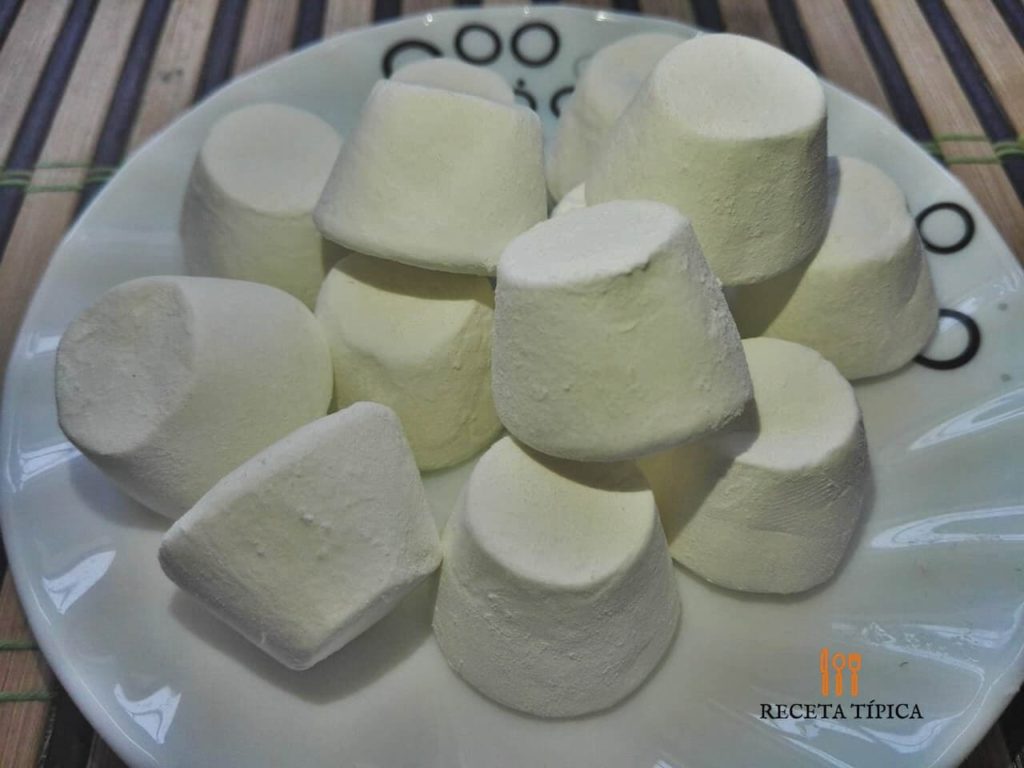
A sugar syrup taken to the thread stage and beaten into dissolved gelatine until the mixture turns white and thick, then set in a tray dusted with powdered sugar and cut into squares.
The thread stage, explained
The second step is the whole recipe and the translation on this page had it as a syrup about to thread, which tells an English speaker nothing.
Here is what it means. Sugar syrup passes through stages as water boils off. Early on it is thin and falls off a spoon in drops. Then it reaches a point where it has concentrated enough to stretch, and a spoonful lifted and tipped falls in a thin thread. That is punto de hebra, the thread stage, and it is where this recipe stops.
Keep going past it and you head towards soft ball, hard ball and eventually caramel, each of which gives a firmer and chewier marshmallow. Sugar moves through those stages faster and faster as the water goes, so the last minute needs watching.
Pour it in a thin stream
The syrup is very hot and the gelatine mixture is not. Tipping the whole pot in at once cooks the gelatine where the syrup lands and leaves lumps that beating will not remove.
Pour it down the inside of the bowl in a thin stream with the mixer already running. It disperses as it goes and the temperature of the whole mixture rises evenly.
Then keep beating. The mixture has to go from clear to white, roughly triple in volume, and thicken to the point where it holds a shape. This takes several minutes and stopping early is the most common failure.
Setting takes hours, not minutes
The last step says to let it cool to room temperature and gives no number, and the card adds up to twenty minutes, which is the time at the stove rather than the time until you can eat.
A slab of hot sugar and gelatine needs hours to firm up, and there is no way to hurry it that does not make it worse. Judge it by touch rather than by the clock: press the surface with a clean dry finger, and when nothing sticks to it, the slab is ready to turn out and cut.
Powdered sugar on every surface
It goes on the tray before the mixture, so the slab releases. It goes on the top afterwards, so the top is not tacky. And it goes on the cut faces, because the inside of a marshmallow is sticky and untreated faces weld to each other in the box within a day.
A knife dusted with powdered sugar cuts more cleanly than a wet one, and a wet knife drags.
More sweet things
- Chocolate bonbons — another sweet with no oven.
- Colombian hot chocolate — where marshmallows end up.
- Chocolate brownies — the tray bake.
- Arequipe and guava cakes — the Colombian sweet counter.
Marshmallows FAQ
The point where the syrup is concentrated enough to stretch. Lift a little on a spoon and let it fall: while it is still sugar water it drops off in beads, and at the thread stage it pulls into a thin strand as it falls. That is when to stop.
The syrup starts moving towards caramel, and marshmallows made with it set hard and chewy instead of soft. Sugar moves through these stages quickly at the end, so watch the pot rather than the clock.
Because it is hot enough to cook the gelatine where it lands. Poured in a thin stream down the side of the bowl with the mixer running, it disperses; tipped in all at once it sets lumps that never beat out.
Until the mixture turns from clear amber to opaque white and holds its shape when the beaters lift. It takes longer than feels reasonable, and stopping early is what gives you a sticky slab instead of marshmallows.
Hours, not minutes. The recipe says to let it cool to room temperature without giving a number, and a hot sugar slab takes a long time to get there. The test is touch: when the surface no longer sticks to a clean finger, it is ready to turn out.
The cut faces were not dusted. Powdered sugar goes on the tray before the mixture, on top after, and on every freshly cut face, because the inside of a marshmallow is tacky.
Fifteen grams is fifteen grams either way. Sheets need soaking in cold water first and then squeezing out, and the water they absorb has to be counted as part of the water in the recipe.
📖 Recipe

Ingredients
- 500 g sugar
- 250 ml water (half for the syrup, half for the gelatine)
- 15 g unflavored gelatin
- 2 teaspoons vanilla extract
- A pinch of salt
- Powdered sugar (for the tray and the tops)
Notas
Instructions
- Put the sugar in a pot and cover it with half the water.
- Bring it to medium-high heat until the syrup reaches the thread stage, which is when a spoonful lifted out falls back in a thin thread rather than in drops. Stir and watch it, because sugar goes from ready to burnt quickly.
- While the syrup cooks, put the unflavored gelatin in a bowl with the vanilla, the salt and the rest of the water, and beat it with an electric mixer.
- When the syrup is ready, pour it into the bowl in a thin stream while beating, and keep beating until the mixture turns white and thick.
- Dust a mould or a tray with powdered sugar and pour the mixture into it.
- Level the top with a spatula and dust it with a little more powdered sugar.
- Leave it to cool to room temperature, then turn it out and cut it into cubes or squares.
Comments
No Comments