
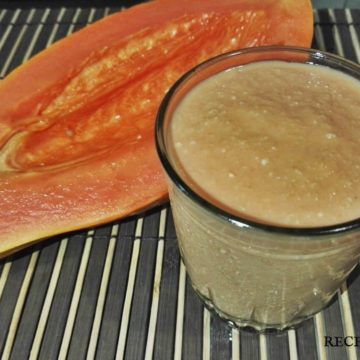
Papaya, raw oats, cinnamon and milk, blended into one thick glass. Five minutes, no cooking, and it works as breakfast rather than as a drink alongside one.
The oats are what make it filling and also what most people get wrong, and the papaya brings one quirk worth knowing about before you make a jug of it.
Why it goes bitter if you leave it
Papaya contains papain, an enzyme that breaks down protein. It is the same substance sold as meat tenderiser, and it does not switch off when the fruit goes into the blender.
Put it with milk and it starts working on the milk proteins. After an hour or two the smoothie tastes bitter, and the longer it stands the worse it gets. Chilling slows it down but does not stop it.
So this is not a make ahead smoothie. Blend it, drink it, and if you want to prepare something the night before, cube the papaya and freeze it instead. Frozen fruit also gives a thicker glass than ice, which dilutes as it melts.
Getting the texture right
Two things decide it: how much oat goes in, and how long you blend.
A quarter cup of rolled oats to a glass is the right ratio. Raw oats swell as soon as they meet liquid, so half a cup in the same glass does not make a thicker smoothie, it makes porridge the blender cannot turn over.
Then give it a full minute. Most people stop at fifteen seconds, when everything looks combined, and the result is grainy because the oat flakes are still whole. You want it to go from speckled to uniformly pale. If your blender is not up to it, let the oats sit in the milk for ten minutes first and they will break down without a fight.
Picking the papaya
This matters more than anything else in the recipe, because a bad papaya cannot be rescued with sugar.
You want skin that has turned mostly yellow or orange with barely any green left, and flesh that gives slightly when you press near the stem, the way a ripe avocado does. It should smell sweet at that end. A hard green one will be watery and faintly bitter, and no amount of honey covers that up.
Ripe fruit also means you probably need no sweetener at all, which is worth checking before you reach for it. Taste the smoothie first and add honey only if it needs it.
What else can go in
Papaya is sweet and a little musky, and the single best thing you can add to it is acid. A squeeze of lime lifts the whole glass and takes about three seconds.
- Lime, half of one, squeezed in at the end.
- Banana, half, for a creamier and heavier glass.
- Orange juice in place of some of the milk, for something lighter and more like a juice.
- A spoonful of yoghurt, for body and a bit of tang.
Berries and other strong fruit will simply take over. Papaya is delicate enough that it disappears behind them, and at that point you are drinking something else.
Making it without dairy
Oat, almond and soy milk all work here, and so does plain water if you want it thinner.
There is a practical advantage too. With far less protein for the papain to act on, a plant milk version does not turn bitter the way the dairy one does, so it survives an hour in a bottle much better.
More things to blend
- Papaya dessert — where the rest of the fruit goes.
- Colombian oatmeal drink — the same oats, drunk hot or cold.
- Milkshakes — the sweeter end of the blender.
Papaya Oat Smoothie FAQ
Because it sat too long. Papaya contains papain, an enzyme that breaks down protein, and it carries on working once the fruit is blended with milk. Within an hour or two the smoothie develops a distinct bitter edge, and the fridge slows this down without stopping it. There is nothing wrong with the fruit or the milk. Blend it and drink it.
No, raw rolled oats blend fine. They just need longer than people usually give them, around a minute, or the smoothie comes out grainy. If your blender is weak, soaking the oats in the milk for ten minutes before blending solves it completely.
Yes, and in Colombia plenty of people do. It is fruit, milk and oats. The idea that fruit does something different before breakfast than after is folklore rather than established fact, so drink it whenever it suits you.
Lime is the best addition by a distance: papaya is sweet and slightly musky, and acid sharpens it. Banana makes it creamier, orange juice makes it lighter, and a spoonful of yoghurt gives it body. Strong flavours like berries tend to bury the papaya rather than complement it.
Look for skin that is mostly yellow or orange with only a little green left, and press it gently near the stem: it should give slightly, like an avocado ready to eat. A rock hard green papaya will be bland and faintly bitter. If it smells sweet at the stem end, it is ready.
Yes. Oat, almond or soy milk all work, and so does water if you want it lighter, though you lose the creaminess. Plant milks have the added advantage of not going bitter, since the papain has far less protein to work on.
Not with dairy milk, for the same reason it goes bitter. What does work is freezing the papaya in cubes and blending it in the morning, which takes about the same two minutes and gives a thicker glass than ice does.
📖 Recipe
Ingredients
- 1 cup papaya, peeled and seeded (ripe, about 150 g; the riper it is the less sweetener you need)
- ¾ cup milk (cold; oat, almond or soy milk all work)
- Sugar or honey, to taste (often none at all if the papaya is properly ripe)
- ¼ cup rolled oat flakes (raw, straight from the packet)
- ½ teaspoon ground cinnamon
- Ice, to taste (optional; it thickens the glass as well as chilling it)
Notas
Instructions
- Put the papaya, milk, sweetener, oat flakes and cinnamon into the blender. Blend for about a minute, until the oats have broken down and the texture is smooth rather than grainy.
- Taste and adjust the sweetness, then pour into a tall glass and add ice if you want it colder. Drink it fresh.
Comments
No Comments