Why is it called chicharrón?
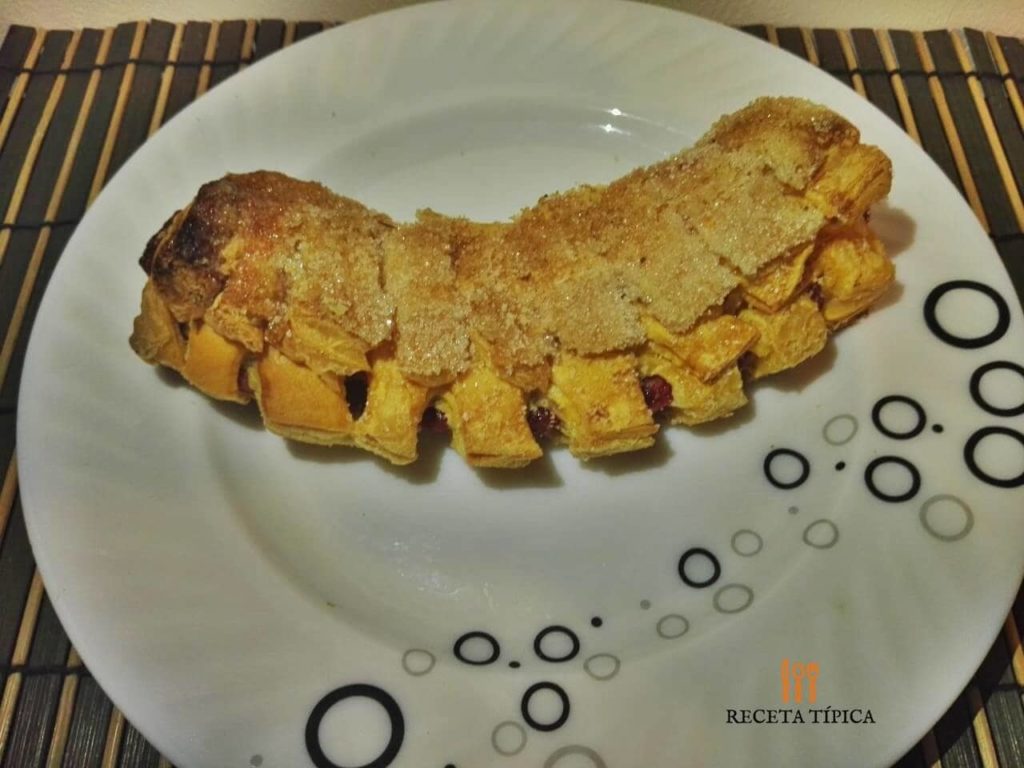
This traditional sweet is made with puff pastry in the form of a pork rind. The filling is very soft, but at the same time, sweet and delicious. That filling is the famous guava candy or guava paste.
Can it be filled with arequipe?
Our traditional sweet chicharrón usually filled with guava paste, and I have not found anywhere that I have eaten it with an arequipe filling. However, I have always said that cooking is a matter of taste, and if you want to change the guava paste by the arequipe you can do it
The sweet chicharrón is a very simple soft and with simple ingredients, and it is also straightforward to make at home. It is sweet that we can find almost that, in any bakery in the country, although I dare to say that, in all, since it is a pretty sweet treat.
As for the dough we use for our sweet chicharrón, it can be homemade puff pastry or the puff pastry they sell frozen in supermarkets, it is or yes, at the time of using the dough it must be thawed.

I can only tell you that it is worth preparing this delicious sweet chicharrón, and if you have not tried it, it is worth doing, its flavor is delicious, and if you accompany it with a glass of milk, you will be delighted. Instead, I do not want to talk more and better. We put ourselves in the exercise of preparing this delicacy that just by thinking that I am going to do it makes my mouth water. Let's cook.
If you liked these sweet chicharrones, you could also prepare homemade donuts or colombian buñuelos.
Receta original en EspañolSweet Chicharrón FAQ
No. Despite the name it is a pastry: puff pastry folded around guava paste, with cuts along the edge so the finished shape resembles a strip of chicharrón. The name describes what it looks like, not what it is made of. It is also called chicharrón de guayaba.
Guava cooked down with sugar into a firm, sliceable block, sold in bars wrapped in dried bijao leaf. In the United States it is easy to find in Latin groceries as guava paste, often the Goya brand. It holds its shape when baked rather than running out of the pastry.
They are what give it the name. Small cuts along the sealed edge spread open as the pastry puffs, so the finished piece looks like the ridged edge of a chicharrón. They are decorative, but they also help steam escape so the pastry does not burst.
Yes, and guava with a mild white cheese is a classic Colombian pairing. A thin slice of queso fresco or mozzarella alongside the guava works well: the salt cuts the sweetness. Keep it thin, or the filling forces the pastry open in the oven.
The edges were not sealed firmly enough, or the filling was too thick. Press the edges down hard with your fingers or a fork after brushing them with egg, which acts as glue, and keep the guava to a single thin slice per piece.
Two or three days in an airtight container at room temperature, though the pastry softens after the first day. A few minutes in a hot oven crisps them up again. They do not need refrigerating and are better not chilled.
📖 Recipe

Ingredients
- 2 sheets puff pastry (thawed if frozen)
- 12 slices guava paste (bocadillo) (sold as guava paste in US Latin aisles)
- 1 egg, beaten (for sealing and glazing)
- 1 tablespoon flour (for dusting)
- 1 tablespoon white sugar (for sprinkling on top)
Instructions
- On a floured surface, unfold one sheet of puff pastry.
- Dust the top with a little flour and roll it out into a rectangle.
- Cut the rectangle into six equal pieces.
- Place a slice of guava paste on each piece.
- Brush the edges of each piece with the beaten egg: it acts as glue.
- Fold each piece over the filling so it is completely enclosed.
- Press the edges firmly with your fingers to seal, then make small cuts along the sealed edge with a knife. These open as the pastry puffs and give the piece its chicharrón shape.
- Repeat with the second sheet of pastry.
- Arrange the 12 pieces on a baking sheet, leaving space between them so they can puff.
- Brush the tops with the remaining beaten egg and sprinkle with sugar.
- Put the baking sheet in the oven, preheated to 200 °C (392 °F).
- Bake for 20 minutes, or until puffed and deep golden.
- Take the tray out and let them cool for about 5 minutes before eating: the guava inside is extremely hot straight from the oven.
Comments
No Comments