
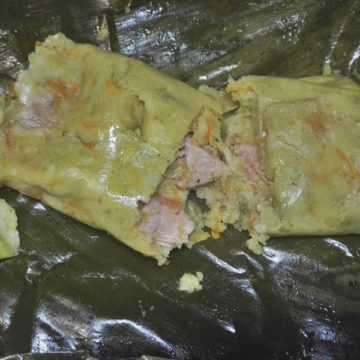
Tamales are one of the most famous and traditional preparations we have in Colombia, one of the most delicious and desired by both Colombians and foreign people who come to visit us. There are chicken tamales, beef, mixed tamales, and these time pork tamales.

They are so delicious and irresistible that I love to prepare them; although they take a little time and effort in their preparation, it is worth considering that effort, making them, and in the end, enjoying one of the most precious things that Colombia has in its gastronomy.
It is perfect for enjoying pork tamales, sharing with the family, where everyone participates in their elaboration. From the moment they are cooking and every detail. It is the best feeling that exists in the world, the moments cooking with family and enjoying with them.
What part of the pork used for tamales?
Here comes the exciting thing, we don't have to adapt only to one piece of the pig, but we can use the ones we like best, today in my preparation I have decided to add pork, pork ribs, and bacon, taking advantage of the parts that I can and those that give a lot of flavors.

If you wish, you can only use the part you like best and continue with the elaboration of the tamales in the way we have been doing it. When it comes to the elaboration of delicacies, I always recommend good pork tamales, so I hope you will be encouraged to prepare them at home, either few or many, and delight yourself with their delicious flavor. Let's cook.
If you liked these pork tamales, you could also prepare wrapped corn cakes or stuffed capon.
Original recipe in SpanishColombian Tamales FAQ
Size, wrapper and filling. Colombian tamales are wrapped in plantain leaves rather than corn husks, and they are much larger: one is a full meal. Inside goes pork, potato, peas and carrot with the masa, all steamed together. Mexican tamales are smaller, husk-wrapped and usually filled with meat in chilli sauce.
In the freezer section of Latin and Asian grocery stores, sold in folded packs. Frozen works perfectly and is the normal way to buy them outside the tropics. Thaw them fully before use and rinse them.
Yes, and it is the step people skip. Pass each leaf briefly over a flame or through boiling water until it darkens and turns pliable. Straight from the pack they are brittle and crack along the fold as soon as you wrap, which lets water into the tamal.
Cabuya and pita are natural plant fibres used as string in Colombia. Plain kitchen twine does the same job. Avoid anything synthetic, since it goes into boiling water for two hours, and avoid anything coloured that might bleed.
Both, and tamales are made in batches for exactly that reason. Assembled raw tamales freeze well for a couple of months; cook them from frozen with extra time. Cooked ones keep several days refrigerated and reheat by steaming, which is better than the microwave.
A torn leaf or a loose tie. Use two leaves rather than one, wrap so the folds sit underneath, and tie firmly enough that the parcel holds its shape when you lift it. Keep the pot at a steady simmer rather than a rolling boil, which knocks the parcels around.
After an hour and a half to two hours, open one: the masa should be firm and come away from the leaf cleanly instead of sticking to it. If it still smears, wrap it back up and give the batch another twenty minutes.
📖 Recipe
Ingredients
- 1 kg yellow masarepa (precooked corn flour) (about 2¼ lb; the same flour used for arepas)
- 5 cups water
- 2 tablespoons food colouring (achiote or saffron) (for the yellow colour)
- Salt, to taste
- Plantain leaves (frozen is fine; soften over a flame or in boiling water before wrapping)
- Kitchen twine (cabuya or pita in Colombia)
- 1 kg tomatoes, chopped (about 2¼ lb)
- 4 onions, chopped
- 2 scallions, chopped
- 5 cloves garlic, minced
- 1 small red pepper, chopped
- Salt, black pepper, cumin and saffron, to taste
- 1 kg pork, cut into six portions (about 2¼ lb)
- 1 kg pork ribs, cut into 6 pieces (about 2¼ lb)
- 2 cloves garlic, minced
- 100 g fatback or salt pork (about 3½ oz; not cured smoked bacon)
- 1 kg potatoes, sliced (about 2¼ lb)
- 250 g fresh peas (about 1¾ cups)
- 400 g carrots, diced or sliced (about 14 oz)
- Salt, black pepper and cumin, to taste
Instructions
- For the dough, put the water in a large pot over medium heat and add salt to taste.
- Heat the water without letting it boil, then add the masarepa slowly, stirring with a wooden spoon, until you have a thick mixture. If it looks too dry, add a little more water. Take it off the heat and set aside.
- Marinate the meat with the garlic.
- For the hogao, cook the onions, garlic and red pepper in a pan. When the onion turns translucent, add the tomato, then season with salt, black pepper, saffron and cumin. Let it cook down until it is thick and jammy.
- Meanwhile, cook the peas in water until soft, and prepare the carrots and potatoes: dice or slice them as you prefer.
- Lay out the plantain leaves. Soften each one first over a flame or in boiling water until it darkens and turns pliable, and check none are torn or cracked along the folds.
- Stir half the hogao through the dough. Spread a portion of dough on the leaves, then add the meats, vegetables and potatoes with a little more hogao on top. Repeat five more times.
- Wrap using one leaf and then a second one over it, folds underneath, and tie firmly with twine.
- Fill a large pot with water, bring it to a boil and salt it. Add the tamales and cook for 1 hour 30 minutes to 2 hours at a steady simmer.
- If the water runs low, top it up with boiling water so the cooking does not stop.
- Drain and serve hot. Open one to check: the masa should be firm and come away from the leaf cleanly.
Comments
No Comments