
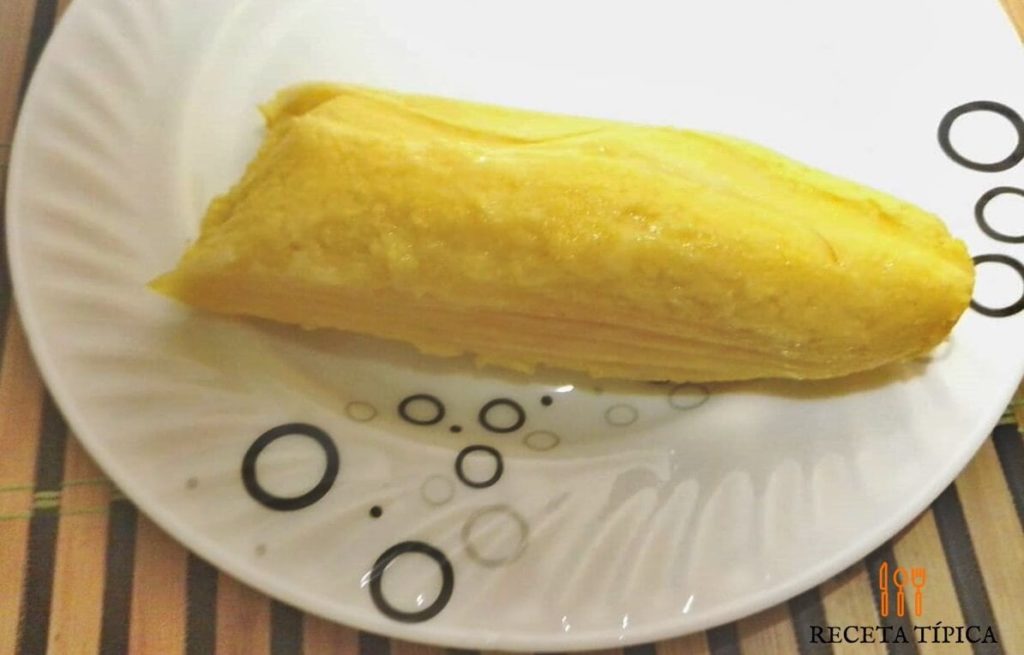
Fresh corn ground to a dough with cheese, egg and panela water, wrapped in the husks that came off the cobs with a strip of mozzarella inside, and steamed. Eight wraps.
Buy the corn whole
The wrapper is not something you buy separately. It is the husk off the cob, and the first step of this recipe is stripping it without tearing it.
That means corn sold loose and already husked is no good here, however fresh it looks. You need the cobs intact, and you need to be gentle taking them apart, because a torn husk leaks dough into the water.
Each wrap uses two, one to hold and one laid over the top. Five cobs gives you enough for eight if you are careful and none to spare, so pick up an extra cob for its husks alone.
The best husks, not the healthiest
The second step used to say to choose the healthiest corn leaves, which is a translation of las hojas más sanas and means something quite different in English.
Sano there means undamaged: no tears, no brown patches, no holes. It is about whether the husk will hold together around the dough for forty-five minutes of steaming, not about nutrition.
So pick the broad, pale, intact ones from the middle of the cob. The outer husks are tougher and often torn; the innermost ones are too small and too thin.
The dough decides everything
Ground fresh corn carries a lot of water and how much varies with the cob, which is why the recipe hedges twice: pour off the excess liquid, and add more cornmeal if it is still loose.
Take both seriously. The dough should hold its shape on a spoon before it goes anywhere near a husk. Loose dough runs out of the ends during steaming and what you unwrap is a husk with a puddle in it.
Grind the kernels short of liquid, too. A blender run too long turns them into juice.
Steaming without a steamer
The twelfth step contains the trick and it is worth spelling out: line the bottom of the pot with spare husks, pour the water in, and stack the wraps on top of the husks.
The husks hold the wraps clear of the water so they steam rather than boil. Covering them with more husks or with foil stops condensation dripping back onto them and making them soggy.
Check every fifteen minutes. A pot that boils dry scorches the husks at the bottom and the smell gets into everything above them.
More corn
- Arepas de choclo — the same fresh corn, on a griddle.
- Crema de mazorca — the cobs blended.
- Cheese arepas — the other corn and cheese.
- Colombian pork tamales — the bigger version, in plantain leaf.
Envueltos de Mazorca FAQ
Fresh corn ground into a dough with cheese, egg and panela water, wrapped in the husks that came off the cobs and steamed. Mazorca is the corn cob and envuelto means wrapped.
Off the cobs, which is why the first step strips them carefully rather than tearing them. Corn sold already husked leaves you with nothing to wrap in, so buy it whole.
Two per wrap, so at least sixteen for eight, plus spares to line the pot. Five cobs is barely enough, which is worth knowing before you start.
Add cornmeal a spoonful at a time until it holds its shape on a spoon. Corn varies enormously in how much water it carries, which is why the recipe has you pour off the excess and keeps cornmeal in reserve.
Yes, the kind sold for tamales. Soak them in hot water for half an hour first so they become pliable, and dry them before filling.
Both at once. There is panela water and raisins on one side and two kinds of cheese and salt on the other, and that contrast is the point of them.
Forty to forty-five minutes of steaming after the water comes to the boil. The dough goes from pourable to set and comes away from the husk cleanly.
📖 Recipe

Ingredients
- 5 tender corn cobs (with the husks still on, you need them)
- 1 cup grated farmer's cheese (queso campesino)
- ½ lb mozzarella cheese (in strips)
- 2 beaten eggs
- ¼ cup cornmeal (and more on hand, in case the dough is loose)
- 4 tablespoons melted butter
- 1 teaspoon baking powder
- ½ cup water with panela (unrefined whole cane sugar, dissolved, not too thick)
- 1 pinch salt
- Raisins to taste
- Corn husks (from the cobs, plus spares)
Notas
Instructions
- Strip the husks off the cobs carefully so they do not tear. You need them whole.
- Pick out the best husks, the ones with no tears or brown patches, wash them, drain them and dry them. Set them aside.
- Cut the kernels off the cobs with a knife.
- Grind the kernels in a mill, food processor or blender, stopping before it turns liquid.
- Tip the ground corn into a bowl, pouring off any excess liquid, and add the baking powder, the eggs, the melted butter, the cornmeal, the salt, the farmer's cheese and the raisins.
- Mix everything well with a spoon.
- Add the panela water little by little, tasting as you go.
- If the mixture is still loose, add more cornmeal a spoonful at a time until it holds its shape.
- Lay the reserved husks out on a flat surface and spread a little dough along the length of each one.
- Lay a strip of mozzarella on the dough and cover it with a little more dough.
- Fold the husk closed and lay a second husk over the top for cover. Fold the ends back underneath and tie with string.
- Set up a pot to steam. If you have no steamer basket, line the bottom with spare husks, pour in water and stack the wraps on top of them.
- Once they are in, cover them with more husks or with foil so the boiling water and steam do not soak them.
- Once it comes to the boil, cook for 40 to 45 minutes over medium heat. Check every 15 minutes and top the water up if it is getting low. Lift them out and serve straight away.
Comments
No Comments