
Arepas made with wheat flour instead of cornmeal, enriched with egg, butter, powdered milk and a little sugar, cooked on a griddle and split open to be filled with cheese.
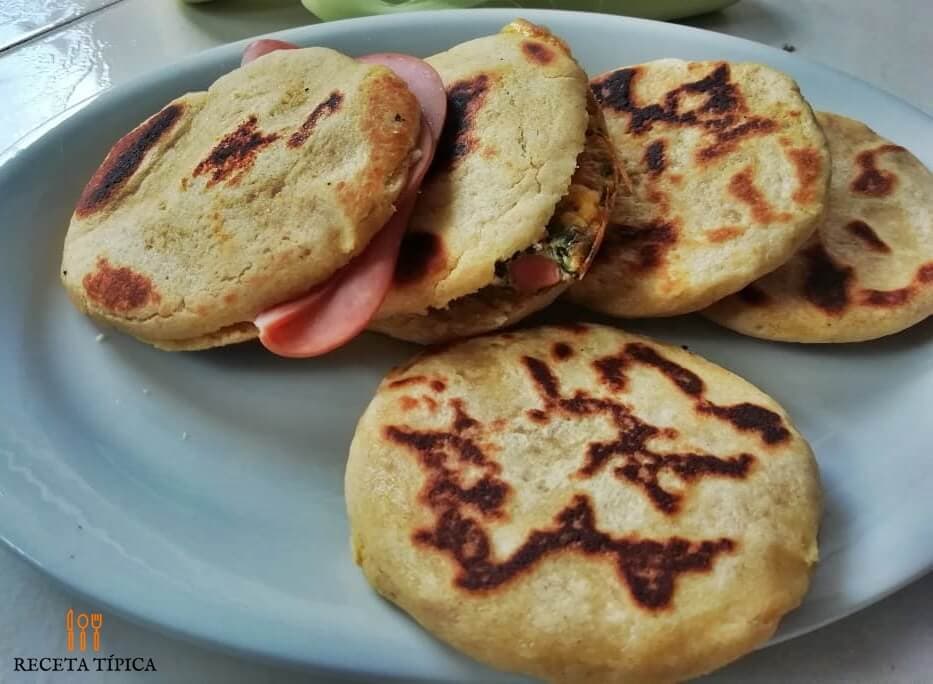
These are not corn arepas
Worth saying plainly, because a lot of people arrive at a page like this looking for the other thing. There is no cornmeal in this recipe. No masarepa, no harina de maíz, no corn of any kind.
It is 250 grams of wheat flour with an egg, butter, powdered milk, sugar, salt and baking powder. The dough behaves like a soft bread dough and the result is lighter and sweeter than a corn arepa, with a crust that browns rather than a pale speckled one.
If what you want is the flour for standard Colombian arepas, that is masarepa, precooked cornmeal, and it is a different recipe entirely.
Water goes in gradually
The instruction is to add warm water little by little while mixing, and there is no quantity anywhere in the recipe. That is not an oversight: flour takes up different amounts depending on the brand, the humidity and how it was stored.
You are aiming for a dough that holds together as a single mass but still gives easily under a finger. Once it has gone sticky, the only fix is more flour, and more flour makes the arepas tougher. Slower is better.
Low heat on the griddle
The original instruction said to cook them in a hot iron, which is a clothes iron in English. It should have said a hot griddle, and the Spanish for that is a plancha or a budare.
The heat has to stay low. Sugar and milk powder both brown fast, so a griddle that is too hot gives you a dark, almost burnt surface with uncooked dough behind it. Each side wants long enough to set and take on colour before it gets turned.
Splitting and filling
These are cooked first and opened afterwards. Once they come off the griddle, split each one through the middle, spread the inside with butter and put the cheese in while it is hot enough to soften.
That is the standard way with this style of arepa, and it is different from the stuffed corn arepas where the filling goes in before cooking.
More arepas
- Traditional arepas — the corn ones, with masarepa.
- Cheese arepas — corn dough with cheese in it.
- Stuffed arepas — filled before cooking.
- Ripe plantain arepas — no flour at all.
Wheat Flour Arepas FAQ
No. Ordinary Colombian arepas are made from masarepa, a precooked cornmeal, and nothing else but water and salt. These are wheat flour, with egg, butter, powdered milk and sugar in the dough, which makes them softer, sweeter and closer to a bread roll.
Masarepa, sold as harina de maíz precocida under brands like P.A.N. or Areparina. Ordinary cornmeal or corn flour will not work for those, and neither will the wheat flour in this recipe.
As much as it takes, added little by little. Wheat flour absorbs different amounts depending on the day and the brand. Stop when the dough holds together but still feels soft.
Sparingly. Extra flour fixes the stickiness and makes the arepas tougher, so it is better to have added the water more slowly. A little on your hands helps with shaping without changing the dough.
Low. There is sugar and milk in this dough, and both colour fast, so a hot griddle gives you a dark crust over raw middle. Low and slow lets the inside cook through.
Divide the dough into equal balls and flatten each one with your hands, or press it under a lid or a plate, which gives a rounder and more even disc.
Butter spread on the cut surfaces and cheese, which is what the recipe says. They are split open once cooked rather than filled before.
📖 Recipe
Arepas de Harina de Trigo (Colombian Wheat Flour Arepas)
Imprimir Pin ComentarIngredients
- 250 g wheat flour (sifted)
- 1 egg
- 2 tablespoons sugar
- 30 g powdered milk
- 40 g butter
- ½ teaspoon salt
- ½ teaspoon baking powder
- Warm water (added little by little)
- Cheese (for the filling)
Notas
Instructions
- Sift the flour and add the egg, the sugar, the powdered milk, the butter, the salt and the baking powder. Mix, adding warm water a little at a time, until you have a dough that holds together but stays soft.
- Divide the dough into balls of the same size and flatten each one into a disc with your hands, or by pressing it under a lid or a plate.
- Cook them on a hot griddle over low heat, letting each side set and colour before turning it over.
- Once they are cooked, split each arepa open, spread the inside with butter and fill it with cheese.
Comments
No Comments