
Arepas two ways: from whole corn cooked overnight and ground by hand, or from precooked cornmeal in five minutes. The first is how grandmothers made them.

Two recipes, one page
What is on this page is two different things that both produce arepas, and they are not close to each other in effort or in taste.
The grandmother's method starts the night before: a kilo of whole shelled corn, an hour in a pressure cooker, resting overnight, then ground through a hand grinder into dough. That is where the flavour people remember comes from.
The other is two cups of precooked cornmeal and two cups of water, kneaded for a minute and rested for five. It is what almost every Colombian household actually does on a weekday, and there is no shame in it.
The steps used to run into each other in one list with the words Precooked arepas: sitting in the middle as though it were an instruction. They are now two clearly separated methods.
Drain the corn
The one step that ruins the traditional method, and the recipe puts it in the right place: before the corn goes into the grinder, not after.
Corn that has spent the night in water and goes into the hopper wet produces a slack, watery dough. It will not hold a shape, it sticks to everything and it cannot be dried out again. The recipe's own words are that it will not serve you.
Drain it properly and give it a few minutes to stop dripping.
Shaping
Two ways, and the recipe describes both. Between your hands, turning the ball and pressing it out with your fingers while smoothing the edge as you go. Or rolled between two sheets of plastic with a rolling pin and cut with a plate or a mould.
The hand method is the technique and it takes practice. The rolled method gives perfect discs immediately and is what most people end up doing.
Either way, watch the edges. Cracks in the raw disc become splits on the griddle.
Ten minutes a side
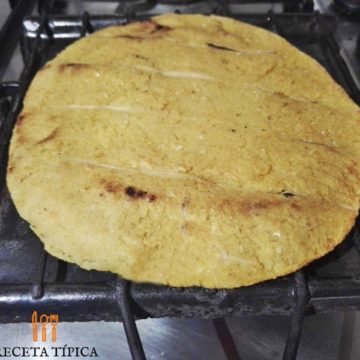
That is a long roast and it is correct for an arepa of this thickness over embers.
The crust should dry out and blister in patches, and the inside should cook through in that time. Checking often is what the recipe asks for, because embers are unpredictable and an arepa goes from blistered to burnt quickly.
On a kitchen griddle it moves faster, so start looking at six or seven minutes.
More arepas
- Cheese arepas — with cheese in the dough.
- Stuffed arepas — filled before cooking.
- Arepa de huevo — fried, with an egg inside.
- Wheat flour arepas — no corn at all.
Traditional Arepas FAQ
The first starts the night before with a kilo of whole shelled corn, cooked for an hour and rested overnight, then ground into dough. The second is two cups of precooked cornmeal and two cups of water, and it takes five minutes.
Corn that has already been cooked and dried, then ground. It only needs water to become a dough. Ordinary cornmeal or corn flour will not work: it has not been precooked and will never hydrate into an arepa dough.
Because wet corn gives a slack dough that will not hold a disc, and there is no way to fix it except adding precooked cornmeal, which defeats the point of the traditional method.
About 10 minutes a side over embers or a grill. What you want is a dry, blistered crust with the inside cooked through. On a griddle it goes faster, so check earlier.
Either between your hands, turning and flattening the ball into a disc, or rolled out between two sheets of plastic and cut with a plate or an arepa mould.
It is too dry. Wet your hands and work a little water in, or smooth the cracks closed as you shape. A dough that cracks now will split on the griddle.
Scrambled eggs and a cup of hot chocolate, which is what the tenth step says and what Colombian breakfast looks like.
📖 Recipe
Ingredients
Grandmother's Arepas
- 1 kilo shelled corn
- Water (enough to cover)
- Salt (to taste)
Arepas from Areparina or Precooked Dough
- 2 cups precooked cornmeal (masarepa or areparina)
- 2 cups water
- Salt (to taste)
Notas
Instructions
Grandmother's Arepas
- The night before, put the shelled corn in a pressure cooker with enough water and cook for an hour over medium heat, on a wood stove or a kitchen stove, until it is soft. Let it rest overnight.
- Drain the corn well before it goes into the grinder. Wet corn gives a watery dough that will not hold together.
- Pass the corn through a grinder until it becomes a dough, neither too coarse nor too fine. It tends to stick in the hopper, so help it down with a spoon rather than your fingers.
- On a flat surface, work the dough into a large ball, pressing it against itself until it is very firm.
- Add salt to taste and knead again.
- Divide the dough into balls the size of a golf ball. Take each one between your hands and shape it into a disc with your fingers, flattening it and smoothing the edges as you turn it.
- The other way is to roll the ball out on a floured surface with a rolling pin, or between two sheets of plastic, and cut a disc with an arepa mould or a plate, taking the excess dough away from the edges.
- Light the wood stove or the charcoal beforehand and set a grill over it, or use a stove grill over medium heat.
- Roast each arepa for about 10 minutes a side, checking often so it does not burn.
- Serve them with scrambled eggs and a cup of hot chocolate.
Arepas from Precooked Cornmeal
- In a large bowl, mix the cornmeal and the water and knead until you have a smooth dough with no lumps.
- If the dough is too wet, add more cornmeal. Let it rest for about 5 minutes.
- Shape the arepas by hand as above, or roll the dough out between two sheets of plastic and cut discs with a plate, taking the excess dough away from the edges. Then cook them on the griddle the same way.
Comments
No Comments