
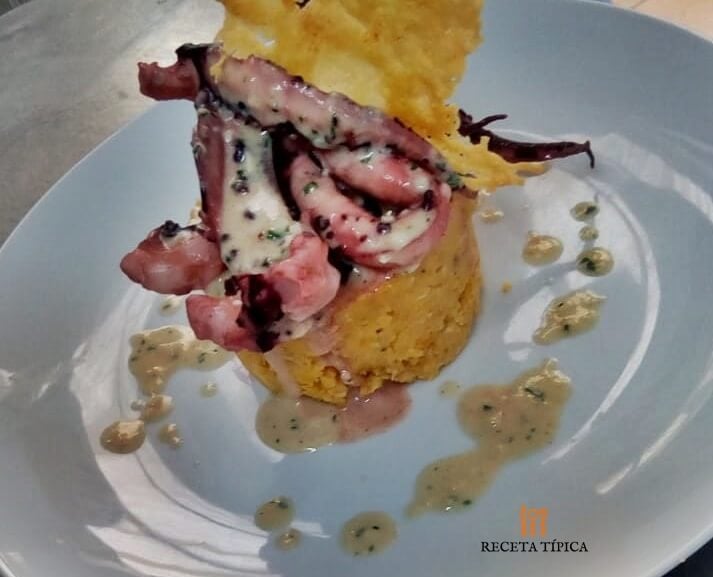
Octopus simmered until tender, marinated in white wine with garlic and thyme, then seared for two minutes and served on a ripe plantain purée with parmesan.
The octopus has to be cooked first
This recipe, as it was published, could not work. It cleaned the octopus, tapped the tentacles with a knife, marinated them for half an hour and then seared them for two minutes in a pan.
Octopus does not work that way. It is almost entirely collagen, and collagen only breaks down with sustained time in hot water. Tapping it with the blunt side of a knife helps, and it is a real technique, but it is not a substitute for cooking: an octopus that goes into a hot pan raw comes out of it inedibly tough.
So the octopus is now simmered before it is marinated. Fifteen to twenty minutes per kilo from the moment the water returns to the boil, then fifteen more sitting in its own water off the heat. The two minutes in the pan at the end are for colour, not for cooking.
Freeze it, and do not salt the water
Two things that make more difference than anything in the ingredient list.
Buy the octopus frozen, or freeze it yourself for a couple of days. The ice crystals rupture the fibres from the inside and the octopus cooks up tender in a way a fresh one rarely does. This is standard practice in Galicia and it is not a compromise.
And do not salt the cooking water. Salt tightens the skin, which then comes away in strips during cooking and takes the best part with it. The seasoning happens later, in the wine and garlic.
Scaring the octopus
The instruction to lower the octopus into boiling water and lift it out three times, a few seconds each, sounds like superstition. It is not.
The Spanish call it asustar el pulpo, scaring the octopus, and the repeated temperature shock helps break down the collagen and stops the skin splitting when it goes in for good. Three dips of about five seconds, then leave it to simmer.
It is the difference between tentacles that hold their shape and tentacles that arrive at the table half naked.
What this dish actually is
Someone arriving from a search for pulpo a la gallega should know what they are getting, because it is not the Galician dish.
Pulpo a la gallega is boiled octopus, sliced into coins, laid on rounds of boiled potato and finished with pimentón, coarse salt and olive oil. Four ingredients past the octopus, and no pan at any point.
This is the Colombian reading of it: the same boiled octopus, but marinated in white wine and garlic, seared, and served on a purée of ripe plantain with butter and parmesan. The plantain replaces the potato and brings sweetness the Galician version does not have.
It is a good dish. It is just a different one, and the page now says so.
More seafood
- Shrimp ceviche — the cold one.
- Trout in mushroom sauce — with shrimp.
- Colombian fried fish — the everyday version.
- Boiled ripe plantains — the purée on its own.
Octopus FAQ
Because it was not cooked long enough before it hit the pan. Octopus is almost entirely collagen, and collagen only softens with sustained time in hot water. Two minutes in a hot pan on raw octopus gives rubber, and nothing done afterwards rescues it.
Roughly 15 to 20 minutes per kilo, counting from when the water comes back to the boil. From 20 minutes onwards, test the thickest part of a tentacle with a skewer: it should go in with a little resistance still, not slide straight through.
Yes, or freeze it yourself for a couple of days first. The ice crystals break down the fibres and the octopus comes out noticeably more tender. It is the single easiest thing you can do for the result.
No. Salt tightens the skin and it tends to come away in strips. Season afterwards, in the marinade.
Not the traditional one. Galician octopus is boiled and served on sliced potato with pimentón, coarse salt and olive oil, and nothing else. This is a Colombian reading of it, with ripe plantain purée in place of the potato.
Dipping it into boiling water and lifting it out three times, a few seconds each, before leaving it to simmer. The temperature shock helps break down the collagen and it is what Galician cooks have always done.
Because it keeps softening off the heat. Fifteen minutes covered in the cooking water after the pot comes off makes a real difference to the texture.
📖 Recipe

Ingredients
- 1 small octopus (frozen and thawed if you can; freezing breaks the fibres and it comes out more tender)
- 100 ml white wine
- Spices to taste
- 1 teaspoon thyme
- 3 garlic cloves (finely chopped)
- Salt and pepper
- 2 or 3 ripe plantains (the blacker the skin, the sweeter the purée)
- 1 tablespoon butter
- A splash of milk
- 40 g Parmesan cheese
- 1 teaspoon sugar
Notas
Instructions
- In a pot of water, boil the plantains, cut in half, until tender.
- Meanwhile, wash the octopus thoroughly and rub any grit off the tentacles. Once it is clean, separate the tentacles.
- Cook the octopus before anything else: bring a large pot of unsalted water to the boil, lower the octopus in and out three times for a few seconds each, then leave it to simmer. Allow roughly 15 to 20 minutes per kilo, and from 20 minutes onwards test the thickest part of a tentacle with a skewer: it should go in with a little resistance still, not slide through. Take the pot off the heat and let it sit in its own water, covered, for another 15 minutes.
- Lay the cooked tentacles on a flat surface and tap them gently with the blunt side of a knife to loosen the fibres.
- Put the tentacles in a bowl with the white wine, the spices you like, the thyme, the garlic, salt and pepper. Mix and leave to marinate for at least 20 to 30 minutes.
- Once the plantains are done, take them off the heat, peel them and mash them in a bowl. Add the butter, the milk, the parmesan and the sugar. Mix well and taste.
- After marinating, sear the octopus in a pan with a little oil for 2 minutes, just to colour it. It is already cooked, so this is only for the outside.
- To serve, spoon the purée onto the plate first and arrange the tentacles on top.
- Serve straight away.
Comments
No Comments