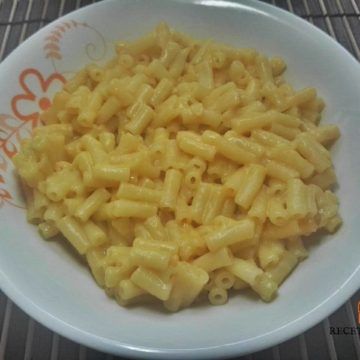
A butter and flour roux loosened with milk, then cheddar, parmesan and cream melted into it and tossed with the macaroni. Twenty minutes, four servings, and the sauce is built while the pasta boils.

Drain the pasta properly
This is the one thing the recipe never said. The first step ended with remove and reserve, and the macaroni went into the sauce with whatever water was still clinging to it.
That water thins the sauce, and a cheese sauce that has been thinned cannot really be thickened again: cooking it down means cooking the pasta further, and the pasta is already done. Drain it, shake the colander, and give it thirty seconds to steam off.
Keep the heat off the cheese
A cheese sauce splits when it gets too hot. The proteins in the cheese tighten, squeeze out the fat they were holding, and what was smooth turns into oil floating over something grainy.
The sauce is already hot when the cheddar and parmesan go in, and that is enough. Medium-low, stirring, until the cheese has disappeared into the milk. Then four minutes at that same low heat and no more.
The roux, briefly
Two tablespoons of butter melted, one tablespoon of flour stirred in until there are no dry patches. Let it cook for a moment before the milk goes in, because raw flour has a taste that survives everything.
Then the milk, poured in while stirring. This is the only point in the recipe where lumps can form, and constant stirring for the first thirty seconds is what prevents them.
The ratio here is loose for a roux, more butter than flour, but the sauce gets its body from 150 grams of cheddar, 50 of parmesan and 200 grams of cream rather than from the flour.
Serve it immediately
Macaroni and cheese is at its best in the first few minutes. The pasta keeps absorbing sauce as it sits, and what was creamy in the pan is stiff twenty minutes later.
If it does have to wait, hold back a little of the milk and stir it in when you reheat.
More pasta
- Meat lasagna — the baked one.
- Pasta soup — a lighter use for the same box.
- Rice with vermicelli — pasta as a side.
- Parmesan rice — the same cheese, no pasta.
Macaroni and Cheese FAQ
Almost always because the pasta went in wet. Water clinging to drained macaroni goes straight into the sauce, and once it is in there the only fix is cooking it back off, by which point the pasta is overdone. Drain it properly and give it a moment in the colander.
Too much heat. Cheese proteins tighten and squeeze out their fat above a certain temperature, and the sauce splits into oil and rubbery threads. Medium-low is enough to melt grated cheese into warm milk.
Yes, briefly. Raw flour tastes of raw flour and no amount of cheese covers it. Stir it into the melted butter until there are no dry patches and let it cook for a moment before the milk arrives.
Add the milk while stirring and keep stirring. Lumps form in the first thirty seconds after the liquid hits the flour and almost never later, so that is where the attention needs to be.
It works but not as well. Bagged shredded cheese is dusted with starch to stop it clumping, and that starch goes into the sauce. Grating a block gives a smoother result.
No. Everything happens on the stovetop and it goes to the table straight from the pan. There is no breadcrumb topping and no oven anywhere in this recipe.
📖 Recipe
Ingredients
- 250 g macaroni
- 2 tablespoons butter
- 1 tablespoon flour
- 1 cup milk
- 150 g cheddar cheese (grated)
- 50 g parmesan cheese (grated)
- 200 g heavy cream
Notas
Instructions
- Cook the macaroni in a pot of salted water for 10 to 12 minutes once the water is boiling. When the time is up, drain it well and set it aside.
- Melt the butter in a pan and stir in the flour until there are no dry patches. Keep the heat moderate so the flour does not catch and burn.
- Pour in the milk and stir until there are no lumps and the mixture starts to thicken.
- Add the cheddar, the parmesan and the cream, and stir until the cheese has melted into the sauce.
- Let it cook for about 4 minutes over medium-low heat, stirring now and then, then add the drained macaroni.
- Mix well so every piece is coated and everything is hot through, and serve immediately.
Comments
No Comments